
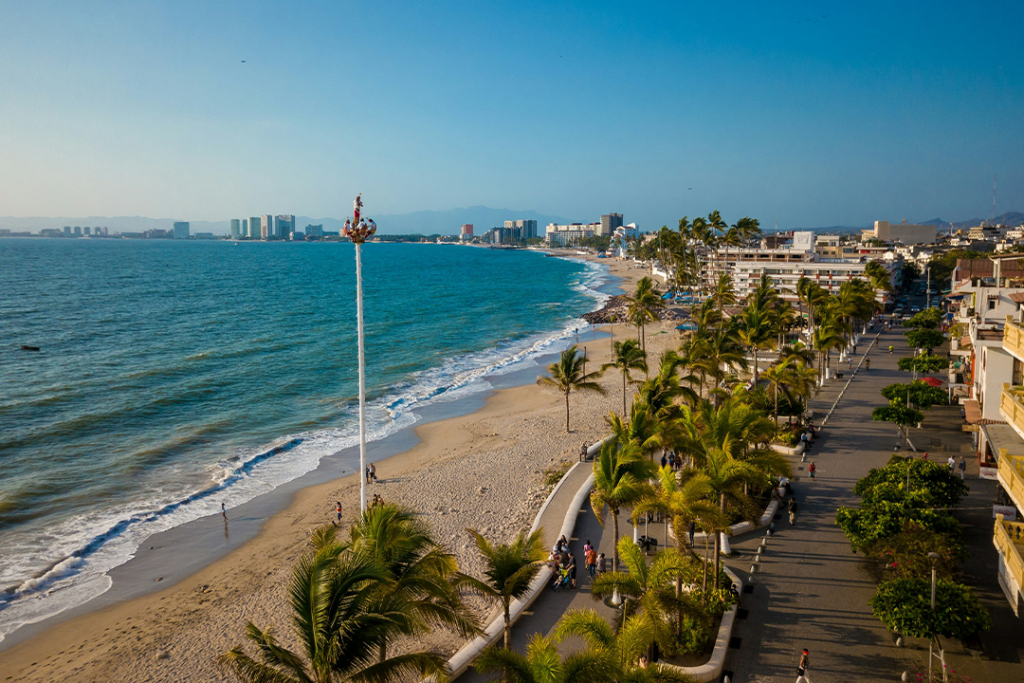
For years, real estate values in Puerto Vallarta seemed to follow a simple logic: the closer to the sea, the higher the value.
Today, that equation is beginning to change.
While still relevant, beachfront location is no longer the sole determining factor. Infrastructure—roads, bridges, access routes, and urban connectivity—is starting to redefine the region's value map.
And it's doing so quietly, but decisively.
Beyond the Ocean: The New Logic of Value
The growth of Vallarta and Banderas Bay is no longer solely driven by tourism. The region has become a more complex urban system, where thousands of people live, work, and commute regularly.
This has changed how property value is perceived. Today, proximity to the sea competes with other equally important factors:
- Commute time to key areas
- Access to services, hospitals, and shopping
- Airport connectivity
- Traffic flow during peak hours
In other words, the market is beginning to value the efficiency of movement as much as an ocean view..
Infrastructure that Changes Dynamics
Some recent and ongoing projects are having a direct impact on how people move—and, by extension, on how areas are valued.
The most obvious example is the Amado Nervo Bridge, which will connect Banderas Bay with Puerto Vallarta more directly.
More than just an isolated project, it represents a significant reduction in travel times and better integration between two markets that already operate as one.
Improvements to highway access, road widening, and the modernization of key interchanges are also beginning to redistribute mobility flows.
And when mobility changes, property values change.
Areas Beginning to Reposition Themselves
This new context is generating an interesting phenomenon: areas previously considered peripheral are beginning to gain relevance.
Areas such as:
- Mezcales and San Vicente, which benefit from greater connectivity to Vallarta;
- Ixtapa, as a natural extension of urban growth;
- La Cruz de Huanacaxtle, which is gaining appeal due to its central location.
It's not that these areas are replacing the traditional ones, but rather that they are beginning to play a more active role on the real estate map.
Value is no longer concentrated in a single area, but is being distributed.
The Time Effect: The True Indicator of Property Value Increase
One of the most important—and least obvious—changes is the role of time in the perception of value.
Reducing daily commute time by 20 or 30 minutes can have a real impact on quality of life.
And that impact eventually translates into increased property value.
This is particularly relevant for:
- Permanent residents
- Service sector workers
- Property owners seeking medium-term rental income
In this sense, property value increase ceases to be merely a financial projection and becomes an everyday experience.
A Market That Is Maturing
What's happening in Puerto Vallarta isn't isolated. It's part of a natural maturation process for any destination that grows beyond tourism.
In the initial stages, value is concentrated in the obvious: the beach, the views, the iconic location. In later stages, the market becomes more sophisticated and begins to value infrastructure, logistics, and urban functionality.
Vallarta is entering that phase.
Read the Map Before It Completely Changes
One of the most common mistakes in real estate is analyzing the market solely in its current state. More experienced investors, on the other hand, try to understand where it's headed.
Infrastructure not only solves existing problems, but also anticipates new dynamics, and in that sense, every new project is a clue about the future of the market.
The real estate map of Puerto Vallarta is no longer drawn solely with coastlines. It's drawn with highways, bridges, access roads, and travel times.
Understanding this change not only allows for better investment decisions, but also allows for a deeper understanding of the market.
Because in the Vallarta of the future, appreciation will depend not only on where your property is located, but also on how well connected it is to everything else.
