
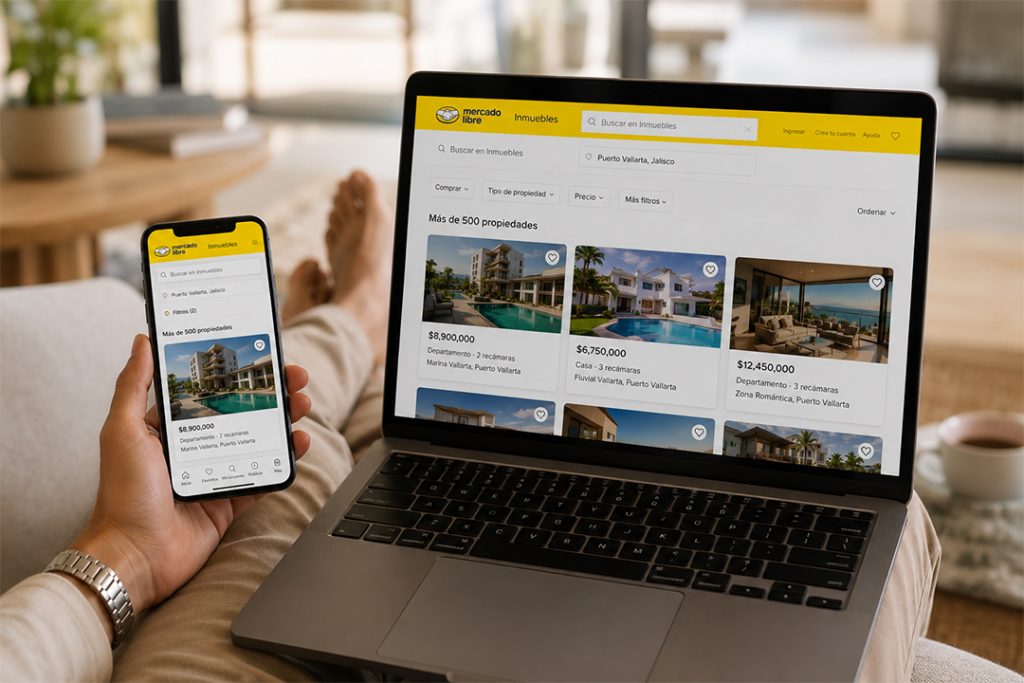
For decades, the real estate business operated on a relatively simple logic: supply depended on physical location, the agent's network of contacts, and, in many cases, the visibility that could be obtained through specialized media, print ads, or personal recommendations. Searching for a property was a fragmented, slow process with limited information.
Today, that reality is changing at a pace that is hard to ignore.
The addition of more than 1,000 new real estate companies to Mercado Libre Inmuebles during the first half of 2025, along with an audience exceeding 90 million monthly visitors and an inventory of over 300,000 active properties each month, reflects something deeper than the growth of a digital platform. It reflects the structural transformation of how people search for, compare, and buy real estate in Mexico.
The question is no longer whether real estate marketplaces are relevant. The question is how much they are changing the rules of the game.
The Buyer's New Starting Point
One of the most significant changes of the last decade is that the real estate search no longer begins with a phone call.
Today, it begins with a screen.
Before contacting an agent, visiting a property, or requesting a quote, most buyers have already conducted preliminary research. They compare prices, review photos, analyze locations, study amenities, and even explore financing options from their mobile phones.
This phenomenon is not unique to Mexico. According to the National Association of Realtors (NAR) in the United States, more than 95% of buyers begin their search process online before contacting a real estate professional, although only 14% of sales are finalized through a real estate portal. The Mexican market is following a similar trajectory.
Real estate marketplaces have capitalized precisely on this shift in behavior: centralizing information, reducing friction, and offering users an experience comparable to that of other digital sectors such as e-commerce or tourism.
In other words, housing is beginning to be consumed digitally long before it is physically visited.
More Transparency, More Competition
The expansion of platforms like Mercado Libre Inmuebles is also changing the competitive dynamics of the sector.
In an environment where thousands of properties can be compared in a matter of seconds, information becomes more transparent, and buyers acquire an analytical capacity that was unthinkable just a few years ago.
This creates a more efficient, but also more demanding, market.
For developers and real estate agents, location is no longer enough. Neither is a good rendering or an attractive advertising campaign.
Properties must compete in real time against hundreds of similar alternatives.
The result is increasing pressure toward professionalization in the sector. The quality of the photographs, the accuracy of the information, the speed of response, and the digital positioning strategy become factors as important as the product itself.
Technology is not replacing the real estate agent; it is raising the bar for what it means to be one.
From Listings to Data Intelligence
Perhaps the most significant transformation lies not in the number of properties listed, but in the data they generate.
Every search, every click, and every inquiry leaves a digital footprint that allows for a deeper understanding of consumer behavior.
The most advanced marketplaces already utilize artificial intelligence tools, predictive analytics, and advanced segmentation to identify demand trends, optimize prices, and connect properties with potential buyers more efficiently.
This represents a paradigm shift for the real estate sector.
For years, many decisions were based on experience, intuition, or limited market insights. Today, more and more players have access to metrics on user behavior, areas of interest, price ranges, and occupancy rates.
The result is a more informed and, potentially, more competitive market.
What does this mean for destinations like Puerto Vallarta and Los Cabos?
In tourism markets, the impact can be even greater.
Destinations like Puerto Vallarta, Riviera Nayarit, and Los Cabos depend heavily on buyers located hundreds or thousands of miles away. For them, the digital experience isn't a supplementary tool: it's their first point of contact with the market.
Before boarding a plane to visit a property, the buyer has already explored dozens of options online, compared prices, and formed an initial impression of the destination. In this context, digital visibility becomes a strategic asset.
Developers and agencies that can clearly communicate their value proposition, support it with transparent information, and leverage available technological tools will have an increasingly significant competitive advantage.
The future is already here.
The addition of more than 1,000 new real estate companies to Mercado Libre Inmuebles in just six months is an indicator of business confidence, but also a sign of where the industry is headed.
The Mexican real estate sector is not only experiencing a digitization of its sales channels. It is undergoing a deeper transformation: the shift from a market based on fragmented information to one driven by data, transparency, and technology.
Buyers have already changed the way they search for homes.
