
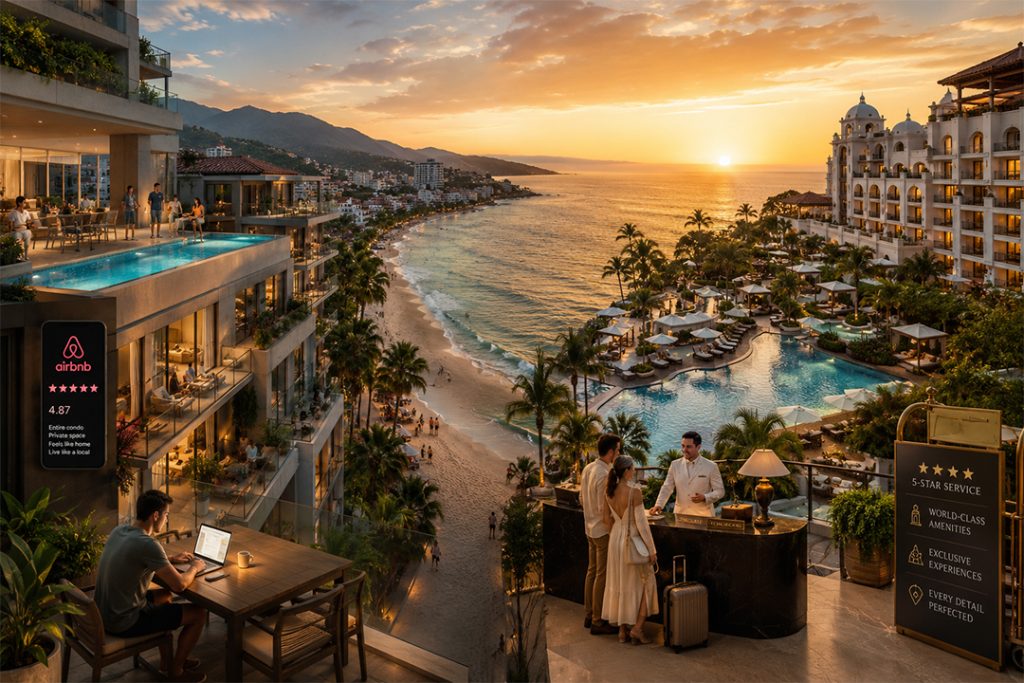
The battle between Airbnb and hotels is redefining tourism and the real estate market in Puerto Vallarta and Riviera Nayarit. For decades, the hotel industry practically dominated lodging in these destinations. However, the emergence of vacation rental platforms has radically transformed the rules of the game.
Today, both models coexist, compete, and, in many cases, are even beginning to merge within a regional economy deeply dependent on tourism. The question is inevitable: who is winning this battle?
The answer is not simple. While hotels continue to lead in infrastructure, traditional tourism, and direct job creation, the vacation rental model is changing the landscape for investors, developers, and real estate owners.
The Size of the Tourism Market in Vallarta and Riviera Nayarit
Puerto Vallarta and Riviera Nayarit form one of Mexico's most important tourism corridors. According to recent reports from the hotel industry and real estate consultancies, the region currently boasts over 40,000 formal rooms in hotels and vacation rentals.
The growth of platforms like Airbnb has been explosive. In areas such as Nuevo Vallarta, Bucerías, Sayulita, Punta Mita, Versalles, and the Romantic Zone, the inventory of properties available for vacation rentals has multiplied in recent years.
The Romantic Zone and Versalles, in particular, have become an international testing ground for this phenomenon. Many recent residential buildings were conceived from the outset under hybrid investment and short-term rental models, incorporating amenities such as:
- Rooftops and infinity pools
- Concierge services
- Coworking spaces
- Digital management systems
- Hotel-style operations
While hotel growth depends on large-scale developments that can take two to four years to complete, the vacation rental inventory is growing at a much faster rate thanks to the boom in pre-sale condominium towers.
Why did Airbnb change the market?
The success of the Airbnb model is due to several factors. For many travelers—especially North Americans and Canadians—vacation rentals offer:
- Greater privacy
- Fully equipped kitchens
- Larger spaces
- More authentic experiences
- Longer stays at competitive prices
Flexibility has also been key. While traditional tourists continue to seek the all-inclusive model, a new generation of travelers prioritizes location, design, and personalized experiences.
This has particularly benefited destinations like Sayulita and Bucerías, where tourists seek a more relaxed and authentic connection with the environment.
Furthermore, the new generation of international buyers is no longer just looking for a second home: they want a hybrid asset capable of generating income even when not in use.
The Hotels' Strong Argument
However, the hotel industry maintains fundamental advantages.
Hotels generate a huge number of direct and permanent jobs in areas such as:
- Reception
- Food and Beverage
- Security
- Laundry
- Maintenance
- Transportation
- Administration
Furthermore, large chains continue to raise the level of tourism sophistication in the region.
Recent projects like Rosewood Mandarina represent multimillion-dollar investments focused on luxury tourism, wellness, and premium experiences.
Many analysts also believe that, during periods of uncertainty, large resorts offer a perception of greater security and operational structure compared to independent rentals.
The Local Economic Impact
One of the most intense debates surrounding Airbnb and hotels revolves around the economic impact.
The hotel industry argues that it generates a broader and more formalized economic impact through taxes, salaries, and supply chains. However, vacation rentals have also created a huge parallel economy around:
- Property Management
- Cleaning and Maintenance
- Interior Design
- Technology
- Concierge services
- Private Transportation
In Puerto Vallarta, a specialized property management industry has even emerged for foreign and domestic owners seeking passive income through short-term rentals.
The reality is that both models fuel the regional economy today. The difference lies in how the money circulates: hotels concentrate operations under a single corporate structure, while vacation rentals distribute income among thousands of owners and small operators.
Is it worth investing in vacation rentals?
From a real estate perspective, the answer remains yes… but with some nuances.
Over the past decade, thousands of investors have purchased apartments in Puerto Vallarta and Riviera Nayarit specifically to operate as vacation rentals.
The combination of:
- Appreciation
- Dollar-denominated income
- High tourist demand
- Flexibility for personal use
has made this model a favorite in the tourism real estate market.
In premium areas, many properties achieve high occupancy rates during peak season—especially between November and April—driven by Canadian and American tourists.
Short-term rental market analysis platforms report that Nuevo Vallarta maintains average rates above $200 USD per night in well-located properties.
The Risks of the Airbnb Model
However, the market also faces significant challenges.
The growing supply has significantly increased competition. Today, simply having an attractive apartment is no longer enough; differentiation increasingly depends on:
- Branding
- Interior Design
- Amenities
- Automation
- Service
- Digital Reputation
There are also regulatory risks. Several cities around the world have begun to limit vacation rentals due to their impact on local housing and the increase in rental costs.
Although Puerto Vallarta and Riviera Nayarit remain relatively open markets, stricter regulations regarding taxes, licenses, and operations are likely to emerge in the coming years.
Added to this is seasonality. Low seasons affect both hotels and Airbnb, and many owners are finding that costs such as:
- Maintenance
- Condominium fees
- Administration
- Platform commissions
can significantly reduce their expected profit margins.
The Future: Hybrid Models
The reality is that there is no clear winner in the battle between Airbnb and hotels. Airbnb and hotels.
Hotels continue to dominate mass tourism, corporate travel, and all-inclusive packages, while vacation rentals lead in flexibility, personalized experiences, and individual real estate investment.
The most interesting aspect is that both models are beginning to merge.
Many residential developments already operate with hotel services, while various chains are incorporating branded residences and private homes within their complexes.
Puerto Vallarta and Riviera Nayarit are entering a new tourism era where lodging is no longer divided between hotels and vacation homes.
The future seems to be heading toward hybrid models where hospitality, real estate investment, and personalized experiences will coexist under the same logic.
For the savvy investor, the real opportunity lies not in choosing between a hotel or Airbnb, but in understanding how the tourism ecosystem is evolving and which properties will be able to remain competitive in an increasingly sophisticated market.
